
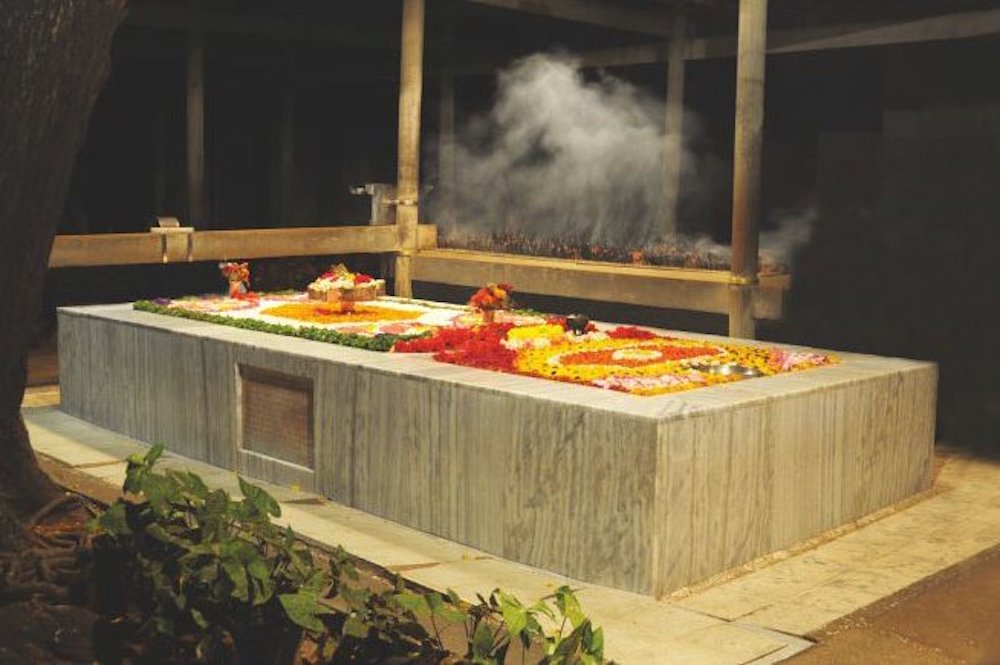
If you ever visit the Sri Aurobindo Ashram in Pondicherry, India, the first thing that will likely strike you is the sheer presence of flowers. The central courtyard, which houses the Samadhi (the final resting place of Sri Aurobindo and The Mother), is perpetually adorned with intricate, vibrant floral arrangements.
But in the practice of Integral Yoga, these flowers are not merely decorative, nor are they just traditional offerings of respect. They are an active, vibrating part of the spiritual discipline itself a profound integration of the natural world into the journey of human consciousness.
This unique relationship with the plant kingdom was primarily cultivated by Mirra Alfassa, known to her followers simply as The Mother.
The Purity of the Plant Kingdom
In Integral Yoga, the physical world is not an illusion to be escaped, but a manifestation of the Divine waiting to be transformed. The Mother had a profound, almost psychic connection to Nature from a very young age. She observed that while human beings are burdened by complex minds, anxieties, and conflicting desires, plants exist in a state of simple, unclouded offering.
When a tree stretches its branches toward the sun, or a bud pushes through the soil to bloom, The Mother saw this as the ultimate symbol of physical aspiration.
“Have you never watched a forest with all its countless trees and plants simply struggling to catch the light… That is precisely the feeling of aspiration in the physical.” — The Mother
Because flowers lack mental and vital interference, their natural state is one of pure receptivity. They are, in a very literal sense, the earth’s silent prayer.
Giving Meaning to Form: A Spiritual Science
During her decades at the Ashram, The Mother cataloged and assigned spiritual significances to nearly 900 different flowers.
It is important to understand that she did not assign these meanings arbitrarily or based on poetic folklore. According to her, it was an occult science. By entering into a deep state of concentration, she would connect with the specific vibration or “consciousness” of a particular flower and translate that vibration into an English or French phrase.
Some of the most prominent examples include:
- The Red Lotus: The Avatar (The Divine incarnated upon earth)
- The White Lotus: Divine Consciousness
- The Hibiscus: Power (with variations in color meaning the power of different spiritual forces)
- The Champak (Plumeria): Psychological Perfection
Flowers as Transmitters of Grace
Because flowers are so pure and receptive, The Mother found them to be the perfect physical mediums for transmitting spiritual forces. When disciples would come to her for blessings, she rarely spoke. Instead, she would hand them a specific flower.
If she handed someone a Plumbago (which she named “Presence”), it was not just a symbol; she was actively charging the flower with the spiritual force of Divine Presence, trusting the flower to hold that charge and transmit it to the recipient.
Sri Aurobindo affirmed this process, writing: “There are three ways of blessing of the Mother: by sight, by touch and through flowers. And it is through flowers that Her blessings are most effective.”
She also noted that the interaction was a two-way street. A flower’s condition in someone’s hand was often an index of their inner state. She observed that flowers would wilt incredibly fast in the hands of someone who was restless or agitated, but would remain vibrant and fresh for days in the hands of someone who was calm and internally open.
The Ecology of Reverence
This profound spiritual relationship with flowers also translated into a deep ecological respect. The Mother taught that we have a responsibility to the earth that provides us with this beauty and spiritual utility.
When disciples asked what they should do with the blessed flowers once they had withered and dried up, she was clear that they should not be thrown in the trash. She instructed them to give the flowers back to the earth. They were to be collected and composted in the gardens, returning their physical matter to the soil to help produce the next generation of blooms.
“One must give back to the earth what it has given us,” she explained, “for otherwise it will become poor.”
The Takeaway
The teachings of The Mother and Sri Aurobindo invite us to shift how we perceive the natural world. A garden is not just biology at work; it is a landscape of living consciousness.
The next time you walk past a blooming bush, or hold a flower in your hand, take a moment to truly look at it. Notice its structure, its color, and its quiet resilience. You are not just looking at a plant – you are witnessing the earth reaching out toward the light.